HUMAN RIGHTS ORGANIZATIONS ADDRESS THE UNITED NATIONS REGARDING SYSTEMIC DISCRIMINATION AGAINST BELIEVERS IN MOLDOVA
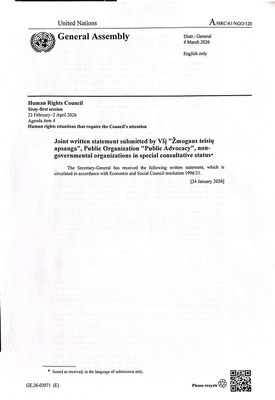
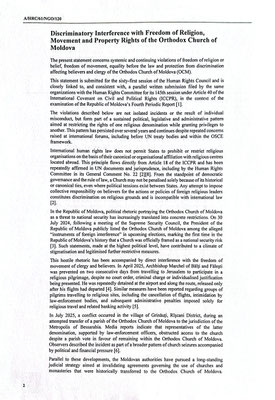
On 24 March 2026, the non-governmental organization Public Advocacy, in consultative status with the United Nations Economic and Social Council (ECOSOC), together with the association “Christian Society for Human Rights” and Public Institution “For Human Rights”, submitted a communication to the UN Special Procedures concerning ongoing and systemic human rights violations in the Republic of Moldova. The submission was also transmitted within the framework of the Human Rights Committee (CCPR) procedure, and its key findings are reflected in a written statement presented at the 61st session of the UN Human Rights Council.
The organizations state that a consistent and institutionalized policy of discrimination against believers of the Orthodox Church of Moldova is emerging in the country. This policy manifests through a combination of measures, including political rhetoric, selective application of legislation, restrictions on freedom of movement, and interference in religious activities.
Particular concern is raised by the fact that representatives of state authorities have publicly characterized the Orthodox Church of Moldova as an “instrument of foreign influence.” According to the organizations, such statements are stigmatizing in nature, undermine the principle of state neutrality in matters of religion, and contribute to the creation of an atmosphere of hostility on religious grounds, in violation of Moldova’s international obligations.
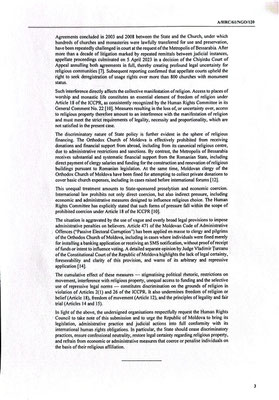
The communication emphasizes that Article 471 of the Code of Offenses is being used as a tool of arbitrary and selective prosecution. The vague and imprecise legal construction of this provision allows for the imposition of sanctions on believers in the absence of sufficient evidence. In practice, penalties are imposed on the basis of assumptions and indirect indicators, demonstrating a systemic violation of the principles of legality and legal certainty.
The organizations also highlight a pattern of systematic restrictions on freedom of movement. Believers are subjected to prolonged inspections, confiscation of personal belongings, and, in some cases, are effectively prevented from leaving the country. The existence of so-called “enhanced control lists” is regarded as creating a de facto two-tier system of citizens, whereby individuals associated with the Orthodox Church of Moldova are subjected to heightened scrutiny without transparent criteria or effective avenues for appeal.
A notable example is the case of Archbishop Marchel, who was prevented from leaving the country on three occasions, including a pilgrimage to Jerusalem to receive the Holy Fire. The organizations consider such actions to constitute a direct interference with freedom of religion, affecting not only the rights of clergy but also the religious rights of a broad community of believers.
Serious concern is also expressed regarding policies aimed at the redistribution of church property. These include measures that could lead to the transfer of up to 800 churches and monasteries currently used by the Orthodox Church of Moldova to the jurisdiction of the Bessarabian Metropolis. Such actions disregard legal succession and the rights of bona fide users of the property, undermine the principle of legal certainty, and create a risk of large-scale escalation of religious conflict. These measures are incompatible with international standards, including Article 18 of the International Covenant on Civil and Political Rights (freedom of religion, including the collective manifestation of worship), which, as clarified in General Comment No. 22 of the Human Rights Committee, encompasses access to places of worship and religious infrastructure. Furthermore, interference with the use of religious property violates the right to peaceful enjoyment of possessions under Article 1 of Protocol No. 1 to the European Convention on Human Rights, as well as the principles of legal certainty and protection of legitimate expectations recognized in the case-law of the European Court of Human Rights.
It is also necessary to highlight the unequal treatment of religious denominations, which constitutes discrimination. The Bessarabian Metropolis receives direct financial support from the Romanian state budget, while the Orthodox Church of Moldova faces restrictions on access to funding. This situation reflects a policy of privileging one denomination while marginalizing another and is incompatible with the State’s obligations to ensure equality and non-discrimination under Articles 2 and 26 of the International Covenant on Civil and Political Rights. In conjunction with restrictions on religious freedom, this also constitutes a violation of Article 18 of the Covenant, as the Human Rights Committee has emphasized that States must maintain confessional neutrality and refrain from measures that exert pressure on individuals’ religious affiliation.
This is further confirmed by events in Dereneu, where force was reportedly used against believers of the Orthodox Church of Moldova. These incidents are seen as part of a broader policy of state support for one denomination at the expense of religious equality, contributing to rising interreligious tensions.
Taken together, these measures — discriminatory rhetoric, repressive application of legislation, restrictions on freedom of movement, and interference with property and religious rights — constitute a systemic pattern of violations incompatible with the International Covenant on Civil and Political Rights.
In this regard, the organizations call on United Nations mechanisms to provide a legal assessment of the situation and to take measures within their mandates to prevent further escalation and to ensure the protection of the rights of believers.
Links:
Written statement of NGO regarding Orthodox Church of Moldova during 61 session of UN Human Rights Council: https://docs.un.org/en/A/HRC/61/NGO/120
Submission of VSI "Zmogaus teisiu apsauga"